
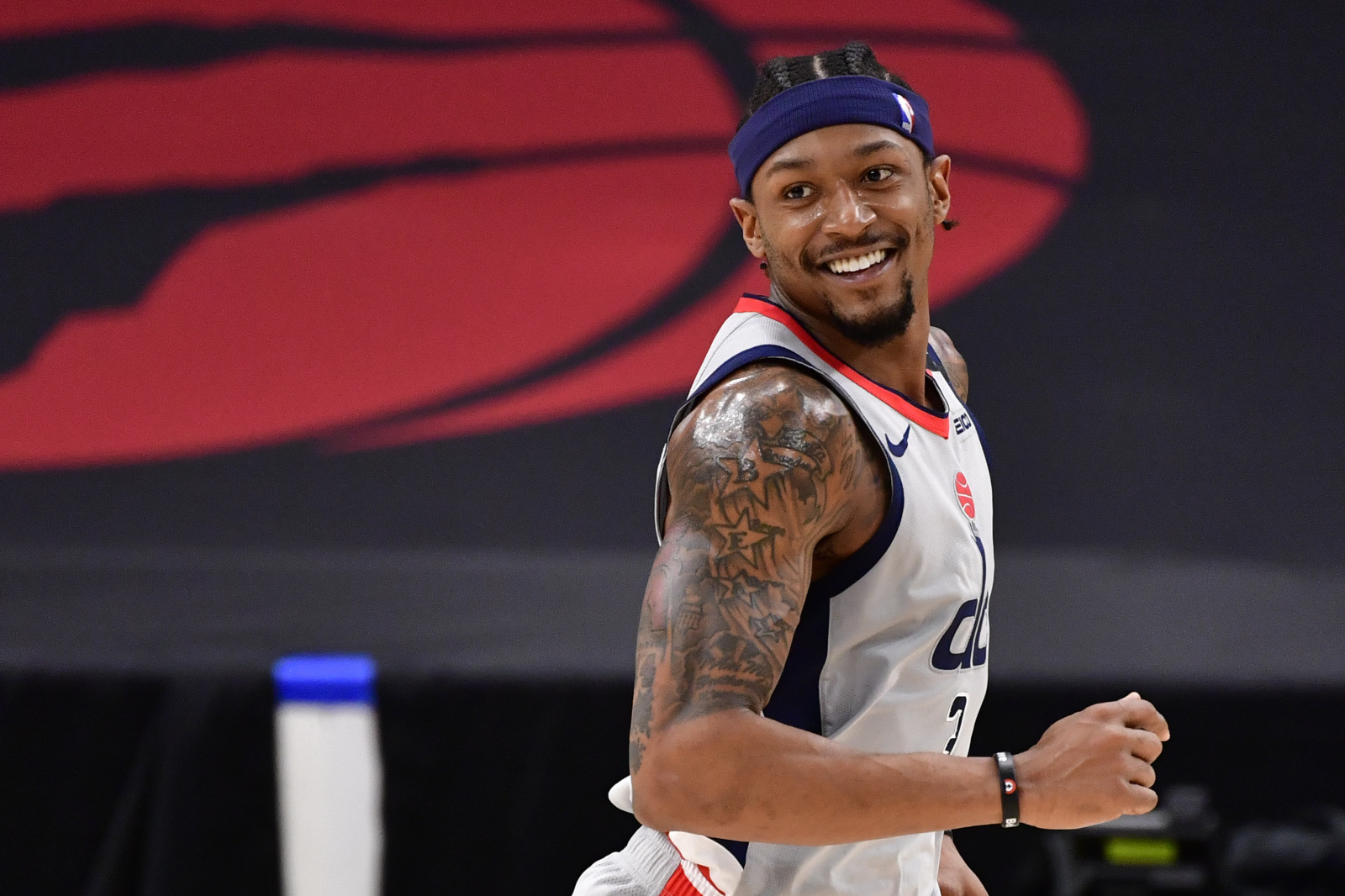

It’s hard to believe that Bradley Beal has now been in the NBA for nine seasons. In that time we have seen his role with the Washington Wizards change more than once. We have seen sidekick Bradley Beal, co-star Bradley Beal, and now face of the franchise Bradley Beal. It may be a “chicken-and-the-egg” concept, but along the way we’ve also seen Beal’s style of play change as the role changes. Beal is now an All-NBA player and perennial scoring champion contender, proving he understood the assignment when the franchise looked to him to grow.
Moving to the Driver’s Seat
The Early Years
The Washington Wizards Drafted Bradley Beal third overall in 2012, two seasons into the John Wall era of the franchise. In those two seasons, Wall averaged 16.3 points, 8.2 assists, and 4.6 rebounds per game, cementing himself as the team’s best player and one of the top young stars in the league.
It really was a perfect pairing. Wall and Beal were two bigger guards that were tough and not afraid of the moment. Wall was a pick and roll maestro and a top playmaker in the NBA. Beal was a shooter first, secondary creator second. While he never became the sniper many foresaw in his college days, he was always looking to knock down a shot off a Wall kick-out.
In his first four seasons, Beal averaged 16 points-per-game and shot just under 40 percent from three point range on 4.5 attempts per game. During this time he battled multiple injuries, and was still finding his footing in the league. This was Beal’s sidekick phase.
The Transition
Beal’s breakout season came in 2016-17 when he averaged 23 ppg and shot 40 percent from three on over seven tries per game. It was also one of the team’s most successful seasons going to a game 7 in the Eastern Conference Semis.
Now things started moving to a new direction. Over the next two seasons Beal averaged similar numbers (24PPG), but these were two injury-plagued seasons for Wall. The team’s point guard played just 41 games in 17-18, and 31 in 18-19. This pushed Beal to start becoming the team’s leader. Wall was healthy at the start of each season, causing the mindset to be the same around Beal, hence the similar play and numbers.
The 2019-20 season was when things officially changed. Wall missed the entire season, and then was traded the following year. In the last two years, Beal has averaged over 30PPG, made the All-NBA Team, and has contended for the league’s scoring champion.
Changing His Play Style
The Mid-Range
Let’s dive into the numbers that aided in Beal’s game changing. In his first three seasons Beal took 31 percent of his shots from three, 43.5 percent from 10ft out to the three point line, and just 25.5 percent less than 10 feet from the basket. This distribution percentage led to a significant reduction in his efficiency. The mid-range game is so tricky to navigate, and only the league’s very best players can do it well. While this is certainly the case for Beal now, as a young player it was not his game. While he was a 40 percent three point shooter in those years, he was just 36 percent in that mid-range game.
Part of the difference in his percentages was the breakdown of assisted vs un-assisted baskets. Over 90% of his threes were assisted, and just 56% percent of his twos were assisted. Assisted opportunities are much easier to convert than un-assisted, especially when the person passing the ball is John Wall.
In Beal’s fourth year he started changing his game. 34% of his shots came from three, 34% came 0-10 feet, and just 32% came from the mid range. This change came with an increase in his 2-point efficiency, and despite a slight dip in his 3 point accuracy, the higher volume increased his True Shooting Percentage overall.
Let It Fly
In Beal’s breakout 16-17 season there was a massive uptick in his three-point attempts. In the lone full season of being Wall’s co-star, Beal took 42% of his shots from the outside. His shots at the rim (0-3ft) also took a jump going up to 24% of his attempts. Threes and layups are where every coach and GM in the league is looking to get shots from, and it’s no surprise that Beal was so efficient doing it with his talent. From 2016-2019 Beal took 62% of his shots from either downtown or at the rim. Beal shot 37% on 7 attempts per game from three during this seasons. In this time Beal went to his first two All-Star games.
Free Throws
In his three years as the co-star, Beal was all about threes and layups. It’s the perfect shot distribution for a second banana to a playmaking point guard. But when Wall was out for all of 2019-20, then traded before the 2020-21 season, Beal’s game had to change yet again. The league’s elite scorers all get to the free throw line. Last season five of the league’s top 10 scorers by points-per-game, were also in the top 10 in the league in free throw attempts. Those players were: Joel Embiid, Giannis Anteteokounmpo, Damian Lillard, Zion Williamson, and Bradley Beal.
In Beal’s first seven years in the league he attempted less than four free throws per game. For his three seasons as a co-star he averaged 4.8. In his two full seasons as the Wizards front man, Beal is taking nearly eight free throws per game, putting him in the top eight of the league for each season.
For an offense to be able to run completely through a player (unless that player is an elite three point shooter such as Stephen Curry or Kevin Durant), that player has to be able to get into the paint to draw both attention and contact from the defense.
Usage
The “usage” stat has grown in popularity in the last five years. James Harden in Houston, and Russell Westbrook’s MVP season in Oklahoma City led that charge. It has become a good barometer of how much an offense really flows through one player. Usage is generally defined as the percentage of a team’s plays, which end the possession, that the player is involved in. In Beal’s first seven seasons, his usage percentage was just over 25%. Just isolating those three years he was a co-star, it rose a bit to about 27.5%. In the last two full seasons it skyrocketed to over 34%. This puts him in the top six in the league each of the last two seasons.
What All of This Means
It has been such a joy watching Beal’s game and standing in the league advance so far. He has really become one of the league’s top scorers, and most notable players. Being able to be a top scorer in the league, on good efficiency, with an entire offense running through you is no small feat. League-wide players and fans have a lot of respect for Bradley Beal. However this season, will truly be his biggest test. The Wizards are firmly in his hands.
This team is the first iteration to truly be built AROUND Beal. His first year as the top guy Wall was still on the roster. Last year, Wall was traded for Westbrook. Another co-star, but not one necessarily a great fit for Beal’s new game. This season the team is its deepest in years, and all with players who compliment Beal’s style.
If Beal can continue this run of excellent play with a better team and compete IN the playoffs not just for a spot, he can really cement himself in the league’s top echelon of players.
Follow us on Twitter!
Visit our Shop!
Discover more from Fantom Sports Industries
Subscribe to get the latest posts sent to your email.
No responses yet